Friday, August 20, 2010

Pride and prejudice; or, how I learned to stop worrying and love clichéd post titles.

I think I was twelve when I first read Pride and Prejudice. I'd initially picked out an abridged copy, a cheap hardcover with garish illustrations intended for kids. We were in the discount bookstore at the outlet mall in North Bend. My mom shook her head no. I'd get the real, grown-up version of the book, or nothing at all.

The real, grown-up version of Pride and Prejudice had much smaller print and was more intimidating, but it did have a pretty painting on the cover; a pale, rosy-cheeked woman was sleeping on a bench, and a timid young man was leaning over her, as if to steal a kiss. It didn't particularly fit the theme of the book, but I liked it.

Of course, Pride and Prejudice isn't really a love story. It's really a comedy of manners. At least that's what everybody always says, but when you're twelve, it's the love story that really captures your imagination. I did understand what Austen was driving at, and her acerbic wit wasn't lost on me, even at that age. But I was taken with the notion of such love. Though it's meant to be a scathing commentary set against the backdrop of a love/hate romance, it's really a love/hate romance set against a backdrop of scathing commentary when you're a twelve-year-old girl.

The protagonist, Elizabeth Bennett, is in many ways an innocent girl. Despite her sharp-tongued posturing, she's a young woman of only twenty, a virgin (one presumes), and knows little of the world beyond what she's read in books. In this way she's an appealing heroine for a young girl. She holds no knowledge that today's twelve-year-olds don't. At the same time, she's whip-smart. She's a beacon of hope for everyone who feels disenfranchised or ignored in a world of excessively silly people.

-

Mr. Darcy is another matter entirely. A wealthy landowner in his thirties, he's miles ahead of Elizabeth in education and sophistication. Though we don't get much of a peek into the details of Darcy's life - the book is almost entirely from Elizabeth's point of view, albeit in the omniscient voice of the narrator - we can fill in the blanks from history. Men like Darcy were landlords, investors, pillars of their community. Because their estates were basically tourist attractions, they had to be prepared to receive unknown guests at any time. They managed huge numbers of hired help, so much so that owning an estate like Pemberley wasn't much different from owning a small company. So while Elizabeth dismisses Darcy as being stuck-up, he is, in fact, a man of wealth and taste.

Because of the novel's limited scope, we get only a taste of insight into Darcy's character. He gets a monologue in which to explain himself, but all he has to say is:

I have been a selfish being all my life, in practice, though not in principle. As a child I was taught what was right, but I was not taught to correct my temper. I was given good principles, but left to follow them in pride and conceit. Unfortunately an only son (for many years an only child), I was spoilt by my parents, who, though good themselves (my father, particularly, all that was benevolent and amiable), allowed, encouraged, almost taught me to be selfish and overbearing; to care for none beyond my own family circle; to think meanly of all the rest of the world; to wish at least to think meanly of their sense and worth compared with my own. Such I was, from eight to eight and twenty; and such I might still have been but for you, dearest, loveliest Elizabeth! What do I not owe you! You taught me a lesson, hard indeed at first, but most advantageous. By you, I was properly humbled. I came to you without a doubt of my reception. You shewed me how insufficient were all my pretensions to please a woman worthy of being pleased.
He also says that Elizabeth is basically exonerated from all wrongdoing in their interactions together because she's "innocent." What he really means is "ignorant," of course, but never let it be said that Darcy doesn't have a way with words. (When he wants to.)

-

The wonderful thing about Elizabeth is that, despite doing a complete one-eighty on Darcy before novel's end, she doesn't really give an inch. She doesn't let her youth or her inexperience quiet her, and she merrily engages him in conversations about life, poetry, and morals. She's not intimidated by him, and we are left to assume that Darcy doesn't encounter this very much.

If Elizabeth is the perfect heroine for a prepubescent girl, then Darcy is the perfect man. Because of the biting social commentary that runs throughout the novel, it's his wealth that is most often complemented - he's handsome, sure, but TEN THOUSAND A YEAR. And what's more attractive to a twelve-year-old girl than money? Think about it: Mr. Darcy could buy you all the gel pens you could possibly want.

And Darcy, for all his passion, isn't sexually threatening. While Austen certainly understood the allure of sex on an intellectual level, there's a compelling case to be made that she died a virgin. There's understanding, and then there's understanding. Darcy's passion for Elizabeth as portrayed in the book is grand, directionless, larger than life. It's hard to connect his declarations with what is basically, at its heart, a desire to bone someone. Darcy's love is pure. It's easy to identify with Elizabeth, to put yourself in her place, because there's no risk of losing your innocence.

-

Joe Wright's 2005 film adaptation is remarkable for many things, chiefly among them this simple fact: he gave Pride and Prejudice a heart. While preserving the basic integrity of the interactions between the characters, he gave them a sincerity and human emotion that is usually lacking. In his Pride and Prejudice, the Bennetts really love each other, for all their faults. Mr. Bennett, rather than being angrily detached, is amused and baffled by the foibles of those around him, but bears them no ill will. Mrs. Bennett is a little less shrill, and some effort is made to understand her. Elizabeth looks young, as she's meant to; she is fresh-faced and grinning and takes on the world, without that weary-eyed "sadder but wiser girl" aspect that's always lurking behind Jennifer Ehle's rosy smiles in the much-lauded BBC adaptation. There is simply no part of her that's not vibrant and alive. More often than we witness her in drawing rooms or dance halls, we see her outside, against a backdrop of trees and rivers and wild growing things. Darcy even proposes to her outdoors, in a rainstorm, and a dialogue that reads biting and bitter on the page becomes something entirely different.

They snarl. They recoil. They reel together; they almost kiss. They are hurt and try to defend themselves, raw and desperate to be understood. One begins to see that they are captivated with each other. The horribly awkward and insulting proposal and the ensuing fight become something new; something they were maybe never meant to be: a mating dance. And it's beautiful.

It's not that Elizabeth and Darcy are devoid of chemistry in the book, or in the BBC adaptation. It's just something different, something so much more human and gritty and wild. The sex is still on the back burner, but it's there if you want to look for it. The way their bodies strain towards each other. The pure, open expression on Lizzy's face as she stands in the sculpture gallery at Pemberley, her eyes traveling without shame over the curves of the naked bodies represented there, appreciating the beauty for what it is, without moral stumbling blocks in the way, lips parted, eyes bright and curious. There is something carved into that marble, something that she longs to know, and Darcy, with his quiet eyes and gentle smile, Darcy will teach her.

-

And I almost forgot the most attractive part of Darcy's character: the quiet, unfettering devotion. However poorly handled at the beginning, however harshly he judged her and her family, he had feelings for her from the beginning. And unlike Lizzy, he was honest with himself. While she would not allow herself to feel affection for someone who didn't fit her ideal image of a partner, Darcy was willing to compromise everything he thought he wanted. And not for her beauty, which is repeatedly said to be inferior to that of her elder sister: for her wit. For that spark in her eyes. All in all, it's not a bad message to send to little girls.

-

When I was twelve, I thought I loved Mr. Darcy. I didn't even know what sex was, but I loved him for what I understood love to be. And I wanted to be like Elizabeth Bennett, like Jane Austen herself: sharp and uncompromising. Strong. Defiant. She may not have meant to tell one of the greatest love stories in literature, and I'm sure that it would make her smile to know it. I'm sure she would laugh at us all for mistaking her comedies for romances. But then she'd catch your eye and you'd know from the look on her face that yes - yes, she was a bit of a romantic at heart.

You could not shock her more than she shocks me;
Beside her Joyce seems innocent as grass.
It makes me most uncomfortable to see
An English spinster of the middle class
Describe the amorous effects of "brass,"
Reveal so frankly and with such sobriety
The economic basis of society.

- W. H. Auden, Letter to Lord Byron

Saturday, July 10, 2010

Creation Sensation vs. Evolution Pollution

Lately I've been reading The God Delusion. This, in itself, is a major accomplishment, because I can never seem to find the time or energy to read anything. But anything about religion, especially something debunking the strange dogma that dominated my childhood, is always welcome.

My grandpa was a preacher. Now he's an atheist. I wish I could sit him down and ask him how you make that journey. Did he ever really believe? Or was he just using the church as a pacifier? I can never remember which denomination he was a part of. Church of God, or Church of Christ or something like that. Probably the most simultaneously uncreative and conceited name for a church ever.

I was never a particularly good Christian, I don't think. I mean, I "got" theology and I prayed occasionally, but all that stuff about being part of the community of believers and praying without ceasing and keeping your mind focused on whatever is pure, whatever is holy, etc. eluded me.

I often remember a conversation I had with one of our pastors. I had been expressing suicidal thoughts to my mom for years at this point, but it took quite a while to convince her that, no, it wasn't all a ploy for attention. (She also straight-up refused to believe that I was engaging in self-harm, because I had the misfortune to pick a method that didn't leave visible marks. Good job me!) So naturally, instead of seeking help from a psychiatric professional, she sicked the preacher on me.

He was a nice enough guy, but he wasn't equipped to deal with that kind of shit. At our first session he asked me what I thought his job, as a preacher, was.

I said: "to bring people closer to God."

It seemed like the obvious answer, but he was surprised that I got it. Apparently, there have been entire books speculating on the subject and all coming up with this "correct" answer that I had just pulled out of my ass.

So my point is, I get Christianity in theory. Unfortunately, at a certain point I began to understand it too well and none of it makes any god damn sense. It's easier to lay blame on people who "misinterpret" the Bible and do weird things, like murdering their neighbors or burning down Planned Parenthoods. But really, the whole thing is kind of a mess.

The Council of Nicaea is problematic. The Bible we know today was heavily edited and censored by a bunch of guys who lived hundreds of years after it was written? Of course you can use that same old "scripture is divinely inspired" argument. But that's the equivalent of responding to every theological problem with "JESUS IS MAGIC!" Even if you believe that God Himself was whispering into the ears of every single person who contributed to the collection of writings that became the Bible, was he also playing eenie-meenie-miney-moe with the Council of Nicaea to make sure they kept all the good stuff and threw out all the books He didn't like? "Let's see...yeah, keep that one, that's fine...that one's good....that one's kinda wordy but we'll go with it....ew, wait, a GIRL wrote a gospel? Who let her do that? Chuck it in the bin!"

I guess it's not that ridiculous, if you believe in that sort of thing. But remember, this is a religion that's actively pursuing converts all over the world. And this is their sales pitch? A mistranslated and misunderstood collection of old writings that was arbitrarily pulled apart by a bunch of dead old white men in the 300s B.C.?

Here are some fun facts about the Bible that you may not know. I didn't, until I started reading books about the Bible that weren't written by somebody like Tim LaHaye.

FUN FACTS ABOUT THE BIBLE THAT THEY DON'T TEACH FUNDAMENTALIST KIDS

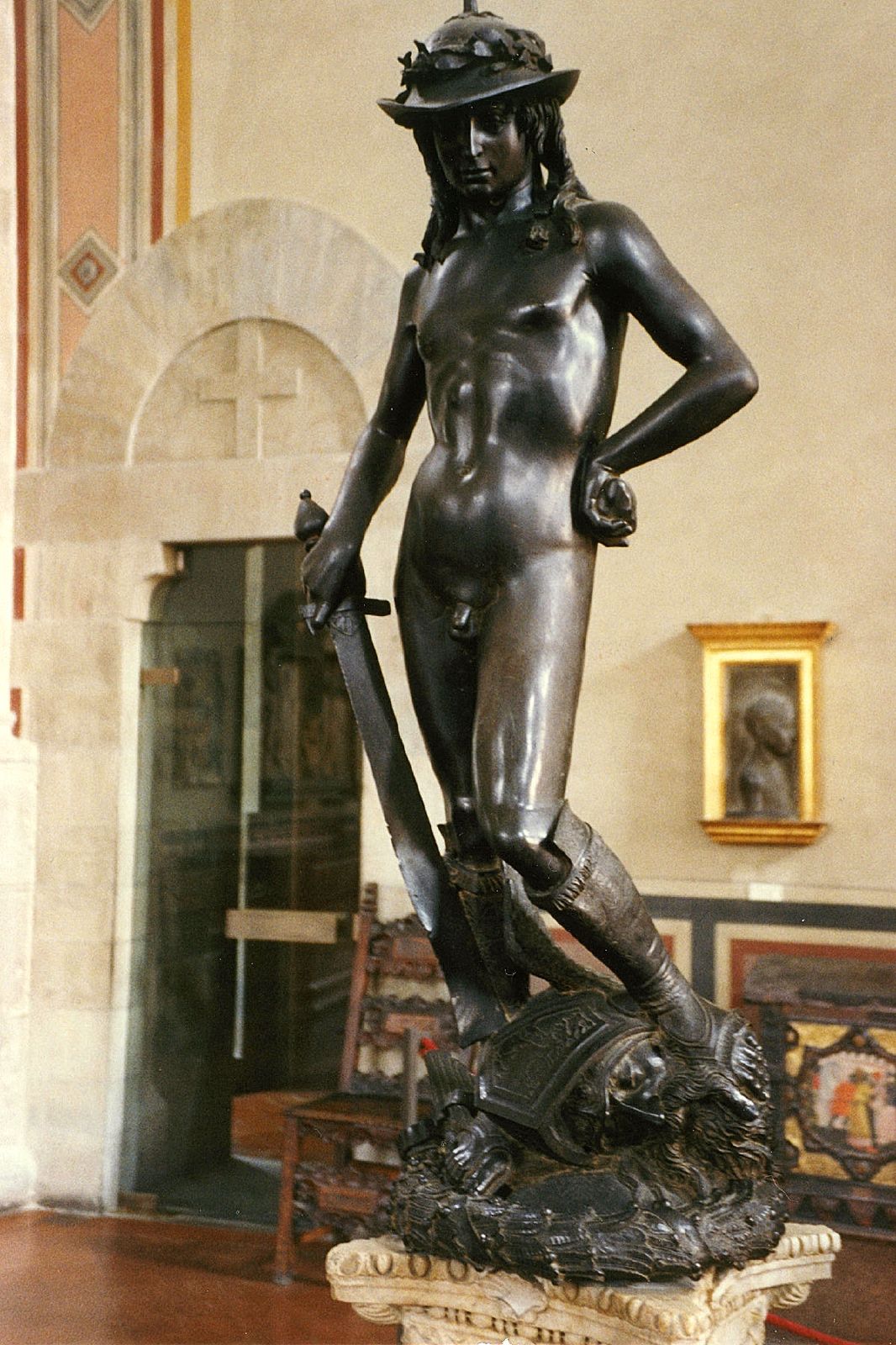
1. Mary Magdalene was probably not a prostitute, or even an adulteress. (Side note: in my five seconds of "research," I ran across this, which is allegedly a sculpture of Mary Magdalene by Donatello. It does not look like how I pictured Mary Magdalene. It looks like if the old cancer-ridden man from Poltergeist 2 tried to dress up as that garbage monster from that X-Files episode where they went undercover in a planned community. Donatello did some pretty good art otherwise, so I'm not sure where this abomination came from. Although, it's worth noting that this is allegedly a sculpture of David. Who was, in case you're still catching up, a man. Just to review: in Donatello's world, this is a woman, and this is a man. Anything you want to tell us, buddy?)

2. That whole mess with Sodom and Gomorrah? Probably had nothing to do with male-on-male sex. This is a classic case of scriptural misinterpretation: one that springs from confusion about how the world has changed in thousands of years, along with poor understandings of ancient languages. And yet we still have the word "sodomy." So, thanks for that, weirdly mistranslated Bible!

3. Onan wasn't punished for masturbating. He was punished for disobeying a direct order from God to get his wife pregnant - Onan wasn't jerkin' it, he was pulling out during sex to "spill his seed on the ground." Despite the fact that even modern translations of the Bible make this very clear, we still have the word "Onanism." Thanks again! (P.S. I do understand that the term originates from Biblical scholars inferring that, because Onan wasn't allowed to spill his seed on the ground, no man should spill his seed on the ground. [Or in a toilet, or in a tissue, or whatever.] That's just unforgivably stupid. It's like saying that because Samson couldn't cut his hair, no man should cut his hair.) (P.P.S. Onan's pretty hot!)

4. Song of Songs has nothing to do with anything else in the Bible. It's just a book of erotic poetry. They don't even really attempt to hide this; how it's managed to stay in the Bible all these years is a mystery to me. There is nothing explicitly religious in the book at all. Instead, we get lines like:

"As the apple tree among the trees of the wood, so is my beloved among the sons. I sat down under his shadow with great delight, and his fruit was sweet to my taste." (emphasis mine)

The only way this could be any more blatant is if it was a banana tree. There's also something in there about how her "navel" is a "goblet" that never lacks "mulled wine." Or maybe it's not "navel." Maybe it's another body part that tastes like wine. Who knows!

5. I wanted to come up with five, but I got bored. There's a decent case to be made that the Apostle Paul was a self-loathing homosexual, but despite the evidence that claim reeks of sensationalism. He could have just been a really weird, tormented guy. I never liked Paul much. His writings disturbed me, which was annoying because he basically wrote 90% of the New Testament. I think I started to become an atheist when one of my well-meaning Christian friends took me to task for disliking Paul's woman-hating stance. The fact that I ever, as a young girl, struggled to understand why I would never be allowed to teach or lead a church or lead a family because of something Paul wrote thousands of years ago breaks my fucking heart. Because I know I wasn't the only one. There were many before me and there will be many after me, and many of them will never even learn to see, let alone shrug off, the heavy yoke of patriarchy that is the New Testament.

I promise I'll get back to The God Delusion. But first I want to quote Bishop John Shelby Spong, in his book Rescuing the Bible from Fundamentalism.

To traffic in guilt as the church has done, to take the beauty and life-giving quality of sexual love and distort it with layer after layer of sexual guilt is simply no longer defensible, if it ever was.
I love that.

Anyway. I've been reading Richard Dawkins' The God Delusion and it's pretty good. As my sidebar quote from Kevin Smith states so eloquently, I've gotten smarter since I was raised Christian. But I still have a lot to learn. The basic scientific principles of evolution and natural selection were glossed right over in my education. I once took a class called "Creation Sensation vs. Evolution Pollution." Surprisingly, this was not a fair and balanced presentation of the facts. As Dawkins points out in his book, Creationists equate natural selection - a well-documented scientific process - with "random chance." It's not even close to the same thing, but nobody ever confronts them on this huge, basic error.

There's a saying about how, if you keep an open mind, people will throw all sorts of garbage in there. That's not necessarily untrue. It certainly happens. But if you keep a closed mind, you're just leaving all the old garbage in there to fester and nothing good ever as a chance of getting in.

Friday, July 9, 2010

I was born a housecat

Our TV is messed up, and I'm the only one who can see it.

I don't understand enough about technology to explain exactly what happened, but our cable provider changed the look of their menus and all that bullshit. So now, any channel that's not broadcast in HD is just sliiiiightly squished so that everyone looks like they're in a very subtle funhouse mirror. A visual aid:

Regular Dave Chappelle


Funhouse Mirror Dave Chappelle


Granted it's not the most egregious thing in the world, and since regular broadcasts look like shit on an HD tv anyway, I'm not to worried about it. What does worry me is that my husband seems completely oblivious.

The other day, we had the following exchange:

Me: Why does the picture look so weird?

Him: Because it's not in HD.

Me: No, I mean, why is it squished?

Him: *curious look*

Me: It's squished. Like, the aspect ratio is off. Everybody looks like they're a little too narrow.

Him: No, they don't.

At this point, I jumped over to the TV and put my hands on either side of the picture, as if attempting to estimate its size. I'm not sure what I was hoping to accomplish. If he wasn't noticing that Kurtwood Smith's forehead was a quarter-inch narrower than usual, me surrounding the picture with my hands certainly wasn't going to trigger a sudden recognition.

Me: SEE????!?!?!?!?

Him: ....

Me: *spontaneously combusts from frustration*

See, the difficult thing about humans - and the reason why I avoid interacting with them unless I absolutely have to - is that they all see things differently. In my world, the picture is warped. In my husband's world, it's not. Who's to say which world is the "correct" world? (Mine is.) (But for the purposes of illustrating a point, let's pretend I didn't say that.)

It's been hot lately. It's been hot and muggy and it's making everybody act like a crazy person. When you wake up every morning feeling like you've been slapped in the face with a hot, wet dishrag, it tends to put a damper on your whole day. I understand this. So I wasn't surprised when a gigantic drama bomb exploded at work earlier today, all because everybody sees things differently and everybody always thinks they're right.

As with most drama bombs, there were about a thousand ways that everyone involved could have behaved that would have defused the drama bomb. But everyone behaved in just the right way such that everyone's feelings got hurt, even people who were barely involved with the situation at all.

Me, I don't get involved in drama. But as the conflict erupted over my head, I felt my stress levels rising ever higher. I hate conflict so much that I can't even stand to be around it. And I hate the fact that people seem to want to cultivate it so much. Doesn't everybody have better things to do?

I don't want to go into the boring specifics of everything, but the whole mess basically started because of a schedule mix-up a few days ago. Then somebody made a phone call to try and straighten it out, harsh words were exchanged between people who have no particular reason to dislike each other, really, and then today there was another mix-up and suddenly everyone within fifty feet was basically forced to become a part of the DRAMA BOMB BAYSPLOSIONNNNN.


And I swear to God, I literally had the thought: "this place would run so much smoother if we only hired robots."

Perception isn't a problem with artificial intelligence. You don't go to turn your computer on in the morning and it's all like, "We never go places anymore! I feel like our relationship is in a rut! Why can't we have adventures like we used to?" and you're all "look, I just wanted to check my email" and your computer's all "well you can check your email IN HELL!" Or maybe that's what it's trying to say every time it crashes. I don't know.

Working with humans is so hard.

Drama rolls off my back for the most part. I think it helps that I basically assume everyone is just looking out for themselves, not necessarily out to get anybody else. If they hurt you, it's incidental. It wasn't their intention. And you can ask them nicely not to do it again, or you can lose your shit and scream at them. Either way it's probably not going to make a damn bit of difference. People are going to keep pursuing their own interests and fulfilling their own priorities without really giving much consideration to how you think or feel.

I don't confront people because I honestly don't think it works. Also, it's fucking awkward and I'm bad at it. My intensely domineering mother left me with zero coping skills for conflict in the real world, unless "curling up in the fetal position and keening" counts as a coping skill. It's hard for me to be around other people's conflict, too, because I see all sides so clearly. I empathize with everybody and I just wish they could all drop their suspicions and hurt and apologize to each other. But that won't happen. We can't just all get along.

I guess I don't see the point in getting angry at people for doing what humans do. Though I'm a peon at work, I'm still in a position where I occasionally have to remind people of the proper protocol for doing things. This means people will often lie to my face about various things, such as:

1. Who, in a position of authority, supposedly gave them permission to break protocol (Are you sure it was the manager? Are you sure it wasn't....nobody?)

2. Whether anyone ever made them aware of that policy

3. How they don't have time to do things correctly

Even though I know these are blatant lies, it doesn't really bother me. I find it more baffling than anything. I wonder if they know that I know they're lying. What, exactly, are they trying to accomplish? Saving face for a brief period of time inbetween telling me the lie and me finding out the truth? (This could be anywhere from a split second to a day or two.) In the end they just end up looking worse. Why would you voluntarily make yourself look like a lying sack of shit?

I have so many questions. Very few answers. And my TV is still messed up.

YES IT IS, GOD DAMN IT.

Friday, July 2, 2010

Why I am not a journalist.

First of all, because a complete stranger told me I shouldn't do it.

I usually follow the advice of strangers. It might actually be the best advice out there, because it always shoots from the hip and never compromises, is never tainted by too much intimate knowledge of the situation. Advice from strangers is pure.

When you're about sixteen or seventeen, all anybody can talk to you about is school. Where are you going for college? What do you want to study? What do you want to be when you grow up? They're astonishingly intimate and searching questions, yet complete strangers are permitted to ask them, because it's presumed that anybody who's about sixteen or seventeen is thinking about nothing but their future.

Really, of course, you don't ever start thinking about your future until it's too late. When you're sixteen or seventeen it's pretty much all about sexuality. It's pretty much all about sexuality your entire life, but when you're sixteen or seventeen it reaches fever pitch. But the point is, when you're sixteen or seventeen you don't really give a shit about college.

So it was Easter, right, and everybody was at church. Our congregation had already outgrown the building we met in, so for the inflated attendance we would rent out a barn. Seriously. It wasn't an old barn filled with hay or anything like that, it was a brand new barn where they held flea markets and stuff. After the sermon, while everybody was milling around waiting for the buffet to be set up, I got roped into a conversation with some woman. I have no idea what her name was. I don't think she went to church often. But she asked me what I wanted to study, and I spoke with a perfect raw honesty that one rarely musters in social situations.

"I want to be a writer," I told her. "But I think I'll study journalism. It's not my favorite, but there's money in it."

She shook her head emphatically. "You shouldn't study journalism if it's not your passion. Study literature. You should do what you love."

Right then, I realized she was right.

-

Secondly, I had a bad journalism experience.

I've hashed and rehashed this story so many times that I feel like I should be done with it, but it still gnaws at me sometimes. I'm not sure why. Okay. Enough editorializing.

I was in a beginning journalism class. The school had a newspaper that was entirely student-run. My teacher, rather than spend a bunch of time making up writing assignments for us, had the staff of the newspaper write up whole stacks of story prompts and hurled them at us like Gambit with his playing cards, only less impressive because he was not an X-Man. Just a skinny, balding guy who constantly wore black "because he was colorblind."

More on that later.

(Not really, but kinda.)

So one day I got a story prompt that told me to attend one session of a weekly conversation group. This group was specifically described as being "faculty and staff only." Right there, a huge strike against me showing up. But they'd provided me with a contact name and information, so I called her up. And called. And left messages. And emailed her. Nothing. Showed up to her office - empty. A colleague informed me that she was on vacation for the whole week.

Awesome.

As the day approached, I went to my teacher - who just happened to be the faculty adviser for the newspaper - and asked him what to do. I told him I wasn't comfortable attending a faculty-and-staff-only meeting without talking it over with someone first - preferably my phantom contact, who was probably sipping Mai Tais in the Bahamas while this whole thing played out, blissfully ignorant of the shitfit she'd be destined to throw in a few short days.

(More on that later.)

Teacher told me to just show up and introduce myself and that it would be awesome and it would make a great story for the paper.

So I did.

And he was right. It was awesome. All three attendees were kind and accepting of me. The topic was race, and the idea behind the group was to discuss race and racial issues in a safe space, free of judgment. I thought (and still do think) it was a great idea. I took copious notes, shook hands with everybody there, and made sure I spelled their names right.

When I got home, the story flowed from my fingertips. I'd been struggling with the class up until this point, mostly due to poor motivation and horrible story assignments. (One gem: "Write about the different selections of food in the cafeteria." Another: "Interview students about their study habits." Riveting, that.) But this was different. This was something that would be published in the paper for sure, and I would be lauded for my accomplishments! Bravo! Bravo! Etc.!

Fast forward a day or two, and Ms. Absent Contact finally returns my email. I was honestly surprised to hear from her at this point, since she hadn't been at the meeting and we'd never met or spoken to each other. As I opened her email, I couldn't imagine what she might have to say to me.

Quite a bit, actually.

She made her feelings on a few points very clear. Namely:

1. I should not have been allowed to attend this meeting.

2. It was "inappropriate" for me to be there.

3. If she had known that I was attending the meeting, she would never have allowed it.

4. Et cetera.

5. It was "inappropriate" (she liked that word a lot) that I'd asked her, in my original email, if I might bring a tape recorder. (Slight digression: yes, I did make the mistake of asking about this. Didn't realize it was a mistake at the time, but looking back, it might have cultivated a lot of ill will. Recording people without their consent is a huge "no no" of journalism, and civilized life in general. When I eventually spoke to my teacher about the incident, he said that one of "their" concerns [exact identity of "their" remains unknown] was that I had recorded them without their knowledge and consent. I thought it was odd that anybody who was in attendance at the meeting would imagine I was recording them, since I was furiously taking notes the whole time. Did they just think I was the most anal student journalist ever? Anyway, of course I didn't hide a god damned tape recorder in my book bag. Jesus Christ. I used much politer language back then, but conveyed the same message - both to Ms. Contact herself directly, via email, and to my teacher, who was acting as some sort of interlocutor between me and Ms. Contact, like she was afraid some of my scummy student-ness would rub off on her or something.)

6. It was inappropriate that one of the meeting's attendees, who arrived "later" (half an hour late to an hour-long meeting, to be exact), was not aware that I was a journalist. He did become aware that I was a journalist long before the meeting ended, and expressed enthusiasm about the story. But none of that mattered, I guess.

So I got called into this emergency summit meeting with my teacher and the head of the newspaper, and had to reiterate that I hadn't secretly recorded the group. Which was pretty insulting, to be honest, but whatever - student journalists had done a lot of stupid shit in the past, so I was willing to submit myself to inane questioning if need be.

Overall, my teacher seemed as baffled as I was. I could never get a straight answer regarding who had come up with the story assignment, or if they had bothered to get in touch with Ms. Contact before writing down her information on the assignment. It would have been even more fucked up if she'd thought it was an awesome idea and then suddenly did a 180 on the whole thing, but sadly I bet the newspaper was just lax and unprofessional. I never heard from Ms. Contact again, despite my very apologetic, polite, and clarifying email. My teacher asked me to send a copy of the story to Ms. Contact and to the lone late attendee, hoping they would see how benign and inspiring it was and give the newspaper permission to publish it.

(And here is where school politics come into play. Really, no one had the right to give or withdraw permission for publication. Especially not someone who wasn't even there at the time. Because the paper was student-run, it was supposed to have complete freedom of the press. But nobody wants to piss off faculty if they can help it.)

And so, even though I had the explicit or implicit permission of everyone at the meeting to be there, write about it, and use their names and quotes, the article was never published. Someone who was not present at the event held ultimate veto power, and wielded it mercilessly. I never did hear again from the late attendee; I'll never know if he was the instigator of this mess, or just a pawn. I did occasionally encounter him, and the other attendees. It was a small campus. None of them would make eye contact with me. Not even the tardy one, when he was showing me how to use the copy machine in the library.

The story kind of has a happy ending. My teacher acknowledged that it was crazy and talked about it in class, as a sort of cautionary tale against...following story assignments? I guess? Or maybe just a warning that sometimes grown-ass adults go batshit when faced with the horrors of journalism. He gave me the extra credit that I would have earned, had my story actually been published.

And, when all was said and done, my portfolio of published stories - while painfully small compared to everyone else's - did include that cafeteria piece, after all.

Must have been a slow news day.

Thursday, July 1, 2010

I don't care if you really care as long as you don't go.

"Here. Take this."

It never failed: any time I had a cold or a flu, or some kind of ill-defined malady, my mom would pour an assortment of small white pills into the palm of my hand. They tasted sweet dissolving on my tongue, so I didn't mind. All of them came from mysteriously labeled dark brown bottles, like something you'd see on the high shelf behind the counter of a nineteenth century apothecary/barber. I vaguely remember her using some strange device in conjunction with the pills; it was made of wood and copper wire and I always got the impression that it somehow helped her determine which pills, and how many of them, I should take.

They never really made me feel better, but what the fuck did I know? I was just a kid. Seeing a timid naturopath once every few years who flinched when he tried to take my blood pressure seemed like a perfectly good substitute for a proper yearly physical. (His temperament and complete inability to commit to any absolute statement, ever, led us to dub him "Dr. Shrug." We used the name so often that I no longer have any recollection of his real one.)

Later in life, I learned more about the little white pills my mom was giving me, exactly what they were made of (lactose) and exactly what they did (nothing). I found it baffling that a woman with a bachelor's degree in chemistry and a master's degree in nutrition could come to the conclusion that, yes! It totally makes sense treat someone who has a disease by giving them a solution of something that causes similar symptoms to that disease, but is completely medically unrelated! Also did I mention it's diluted so many times that basically nothing of the original substance even remains? That makes it even better!

Lots of Christians would reject homeopathic medicine - not because it makes literally zero sense, but because it has ties to New Age healing which is obviously a direct product of SATAN. Most of them will just cringe uncomfortably if someone brings up incense or psychics or tarot cards or gargoyles, but Marguerite Perrin, the infamous "God Warrior" from Trading Spouses and the unlikely muse who led to the creation of this blog, takes it a step further.


(Every time I've run across this video, the husband always reminds me uncomfortably of someone. I just now realized that it's Joe Don Baker.)


When I was little, my mom warned me to stay away from Ouija boards the same way she warned me to stay away from guns. Once she told me that she quit messing around with astrology because "it got too creepy." (Assuming "creepy" means "dumb," then yes. Yes it did.) (Seriously, though. I took Psych 100 at a community college. It was a big class. The teacher asked for a show of hands - who believed that astrology had any kind of merit whatsoever? One girl raised her hand. One girl out of a class of, like, 40. At community college.) (Think about it.)

My dad, to his credit, didn't buy quite as easily into the Jack Chick brand of theology. I think - I'm not sure, but I think - he was sharp enough to realize that kids playing around with fake-ass "mysticism" wasn't an open invitation for SATAN to possess their souls. But how do you draw that line? How do you say, "okay, God's real, but demonic possession? Pffft, that's just silly."

It's a question worth exploring. Which is why I wanted to write this blog.

-

She is not a ChristiunnuUUUUUUUUHHH!